Wednesday, April 6, 2011

Pen vs Reel: One Flew Over the Cuckoo's Nest

Is the pen mightier than the reel? It's an age old question that has always seemed to have a single answer: YES. Time and again we have had some excellent books adapted into movies. Some of the movies have gone on to become cult classics; some have bombed badly, sometimes even tarnishing the reputation of the books. I recently had an experience where I read a book, considered a classic by most, and the movie made out of the book has also been labeled as a classic, winning 5 Oscars. The book - and movie - in discussion here is 'One Flew Over the Cuckoo's Nest'.

The Book
  
'One Flew Over the Cuckoo's Nest', authored by Ken Kesey, narrates the vagaries of the inmates of a mental asylum. The asylum, under the hard-nosed rule of head nurse Ratched, consists of people deemed to have insane behavior which is curable (The Acutes) and people who are deemed to have incurable metal illnesses that have rendered them incapable of leading a normal daily life (The Chronics). The entire story is told from the point of view of an American Indian referred to as 'Chief' Bromden. Bromden, who is in perfect physical condition, is mistaken as a deaf and dumb individual. This enables him to listen in on all the happenings in the asylum while staying out of everyone's suspicions. His childhood and other experiences outside the asylum, and the observations that he makes in the asylum have led him to believe that the higher authorities (whom he calls as The Combine), Nurse Ratched in the asylum for instance, always try to segregate people who do not conform to the social norms. In his long stint inside the asylum, he has come to consider the asylum as the metaphor for the society that exists outside the asylum.

However, the arrival of Randle Patrick McMurphy shakes the asylum inmates out of their daily torpor as he goes about upsetting the daily routines of the ward. A criminal who has managed to convince the judiciary that he is indeed insane, walks into the asylum expecting to stay in there for a few months and then getting out. With this misconception in his mind, he proceed to wreak havoc in the carefully laid out time drill by Nurse Ratched. Though he tries to conform to the ward policies once he comes to know that his release is dependent on the reports submitted by Nurse Ratched, he soon realises that the rules and regulations implemented by Nurse Ratched are illogical and aimed at maintaining a tyrannical hold over the inmates of the asylum. The never-ending struggle of McMurphy against 'The Combine' in the asylum forms the central theme of the book.

From what I could interpret of the book, the book seems to be an effort to convey the struggle of an individual against a system hell bent on bringing back the medieval ages. It also dwells upon how the individual can be forced into conformity if he/she does not keep his/her wits about and refuses to think sensibly. These particular themes have been covered in a lot of different form of literature. Hence, I did not find the book as great as it is made out to be. Though from what I had heard and read about the book, this book is supposed to be a metaphor for the norm prevalent in American society at that time.

Having said that, I must say that the characters created by the author are very intriguing and well crafted. Also, the style of narration throughout the book - from 'Chief' Bromden's point of view - is very compelling. I won't go into further details of the book because - despite the theme being nothing out of ordinary - this book is worthy to be read at least once.

The Movie

Having read the book, I was quite interested in watching 'One Flew Over the Cuckoo's Nest' - the movie. It has a rating of 8.9/10 on IMDB, and has won the 'Big 5' Academyawards (best movie, director, actor, actress, and adapted screenplay). First and foremost, I did not expect the movie to be as good as the book (they rarely are), but having seen masterpieces such as The Godfather, Lord of the Rings, Jurassic Park, and so on, I was hopeful of a good movie. However, I must confess that I was left disappointed.

The characters in the movie all seem to be botched up. Admittedly, Jack Nicholson does a good job as McMurphy, but still falls short of capturing the dubiousness of the character depicted in the book who leaves us guessing at times as to what his true motives are. The beauty of 'Chief' Bromden's character is the fact that he is the narrator in the book and hence, given his experiences as a child, we get a fascinating insight into the various elements at play in the asylum. In the movie however, relieving Bromden of his responsibility as a narrator means that he is quite literally rendered as a mere sideshow; the only exciting point involving him being the scene where he reveals to McMurphy that can actually listen and speak. Even the rest of the asylum inmates (maybe except for Billy Bibbit) lack the depth of character shown in the book.

The biggest disappointment however is Nurse Ratched. She's been reduced to a simple caricature of the actual character painted in the book. One of her biggest weapons is supposed to be her voice which she uses to manipulate - and at times provoke - the inmates. Louise Fletcher, however, fails to capture this and looks quite robotic. Another high point of the book is the relationship between McMurphy and Nurse Ratched - sometimes bordering on sexual innuendo. The director seems to have made no effort to capture the same.

One more thing that I thought was missing was the smooth flow of events that has been shown in the book. The movie just seems to move on randomly rather than following a definite plot. Director Milos Forman has captured the movie well in parts but does not do a very good job of linking those parts to form a good story.

All in all, I would say that Forman fails to do justice to what could have turned out to be a very good movie. I know most people seem to like the movie (as is evident on all the movie websites; it has a freshness rating of 96% on Rotten Tomatoes), but somehow, it just did not click for me. I would advice: read the book, and the movie, you can miss.

Wednesday, February 9, 2011

In Hibernation


'Tis a time to slog not to frolic and play.
Thus says the clock commanding attention.
The mind struggles on, wanting plenty to say.
Mourning the days of coerced hibernation.

Thursday, January 6, 2011

Book Review: 'J.R.R. Tolkien: A Biography' by Humphrey Carpenter

Normally, biographies do not rank too high on my reading list. There must be barely a handful of biographies that I must have read – mostly at someone else’s urging – and I must confess that it was not a very enjoyable experience. Forgive me if I appear too snobby, but reading about other people’s life kind of bums me out. However, when I came across J.R.R Tolkien’s biography, it was hard to pass up the opportunity of reading it. For those uninitiated, John Ronald Reuel Tolkien is the author of the epic fantasy novel ‘The Lord of the Rings’ and the creator of that mythical place called the Middle Earth. It must be known to many Tolkien fans that he was not a great advocate of biographies. This was partly because he was an extremely private person and also because his point of view was that a biography should talk about the person’s work rather than the other aspects of his private life.
However, Humphrey Carpenter hit the jackpot when he managed to convince Tolkien to allow him to document his life. What’s more, Tolkien actually lent Carpenter his personal notes and a few letters that he had written. To his credit, Carpenter has done a splendid job to record the annals of Tolkien’s life in a riveting manner that traces Tolkien’s work while intertwining it with his life and how his life influenced his work.
Carpenter tells Tolkien’s story right from his birth in South Africa and follows it to the end in England. While some may debate that such a detailed account was irrelevant and not quite in deference to Tolkien’s idea of a biography, it must be said that one needs to know about the events mentioned in the book to understand how Tolkien came about to writing such masterpieces as The Silmarillion, The Hobbit, LOTR, and so on. The author has done a great job to trace the origins of various characters, significant or otherwise, events, places, and, most importantly, the Middle Earth right back to people, events, and places in Tolkien’s own life. Another refreshing quality of the book is Humphrey Carpenter’s taut writing. At no point does one feel too bored or feel the need to skip a few pages. Infact, there are instances in the book where you can’t help but get a few goose bumps.
That Tolkien was meticulous is quite apparent after reading his books – especially the lengthy appendices that he’s written for LOTR – but just how far he could go with his meticulousness has been captured quite succinctly in the book. One contrast that jumps out quite often – atleast to me – is that for a man who wrote such great epics, Tolkien led a remarkably simple life. This is especially astonishing considering the almost celebrity like status that a lot of authors enjoy today despite having written something that is not half as good as his work. One thing that you can make out quite easily from the book is that he considered himself a philologist above everything else. Indeed, but for his love for languages, we might have not had one of the greatest mythologies ever told.
Another important facet of his life that has been captured in the book is the literary clubs that he was part of. The many hours that he spent in the company of fellow members of the ‘Tea Club and Barrovian Society’ (T.C.B.S in short) initially and the ‘The Inklings’ eventually, undoubtedly acted as a stimulant to his terrific imagination. Tolkien’s friendship with C.S Lewis, the author of the Narnia series, is well known. Carpenter explores how their friendship affected their writings and the views that they held about each other’s works.
I can assure you that once you are finished with this book, it will be hard to resist picking up your LOTR copy and reading it again. This one is a must read both for Tolkien fans and for those who are yet to experience the magnificent realm of Middle Earth. 

Friday, December 31, 2010

Movie Review: Gulliver's Travel

Given Hollywood's over-reliance on novels and comic books to come up with new stories lately, it was inevitable that Jonathan Swift's epic would soon be adapted on-screen. Though what Rob Letterman came up with was an unexpected amalgamation of the 18th century tale with 20th century culture. Ofcourse the end result left an unexpectedly sour taste in the mouth. The 20th century version of Gulliver's Travels tracks the journey of Lemuel Gulliver, a mailman in a magazine, to Liliput and back in an attempt to appease and woo his lady love. It's a typical Jack Black comic movie with lots of gaffes and very gags. However, unlike School of Rock, this time it fails big time.

Unfortunately, there's nothing much to talk about this movie. It has it's moments, but overall it's a very shallow plot which has reduced an all time classic to a bit of a joke. The story jumps a few steps ahead in many places leaving the viewer clueless. Most of the performances are pretty flat (expected a bit more from Jason Segel). The idea of having the Liliputians talking in a mock old English sing-song accent looks good initially but gets cumbersome over time. Jack Black is his usual exuberant self and is the only saving grace of the movie.

There are a few funny moments which I won't reveal at the risk of giving away the only funny moments to those who still want to watch the movie. Overall, this movie is a massive snooze fest and I would rather that Gulliver goes on his travels alone this time than having us watch them. This could have been a much better movie given the concept that Letterman has applied. However, as it is, it's one adventure to avoid.

Monday, September 20, 2010

Pondicherry - A Slice of Paradise

----------------------------------------------------------------------------------------------------------
this post being a continuation of the previous two posts of my trip to Pondicherry

Part 1      Part 2
----------------------------------------------------------------------------------------------------------

Day 2 - The good and the best

We had three objectives lined up before us this day: the Auroville Township, the Aurobindo Ashram, and a beach. For transportation, you can get bikes on hire in Pondicherry for commutation around the city. Another option is to hire an auto rickshaw to take you around for the whole day for a pre-decided price. Normally, the guest house owners will have a few rickshaw wallas on their payroll who will take you around the city and outside and wait for you while you go around. A general lack of ability to maneuver a two-wheeler meant that we had to rely on the latter option.
A Prototype of the Auroville Township

Solar Food Oven
Auroville is supposed to be an 'experimental' township which aims at bringing people from different countries, religions, and cultures together to live in harmony. The basic requirements for a person to be an Aurovilian are that they have to renounce all religion and be ready to explore oneself (quite lofty I know). There are some more requirements which they have stated on their site. According to our guest house owner, it's a place that most foreigners with shady past seek after their own country becomes too hot for them to stay put. Whatever the truth may be, the place surely is a very good sanctuary for anyone trying to lead a peaceful life; provided you agree to follow their ideals. While I did not quite agree with what they had to offer in terms of philosophical enrichment, I certainly liked what they had done with the natural resources available to them. From water harvesting to waste management, Auroville has made effective use all the limited means available to them, something that we can follow instead of cribbing about global warming and the exhaustion of natural resources through wastefulness.


The Matrimandir
A Prototype of the
Inner Chamber of Matrimandir
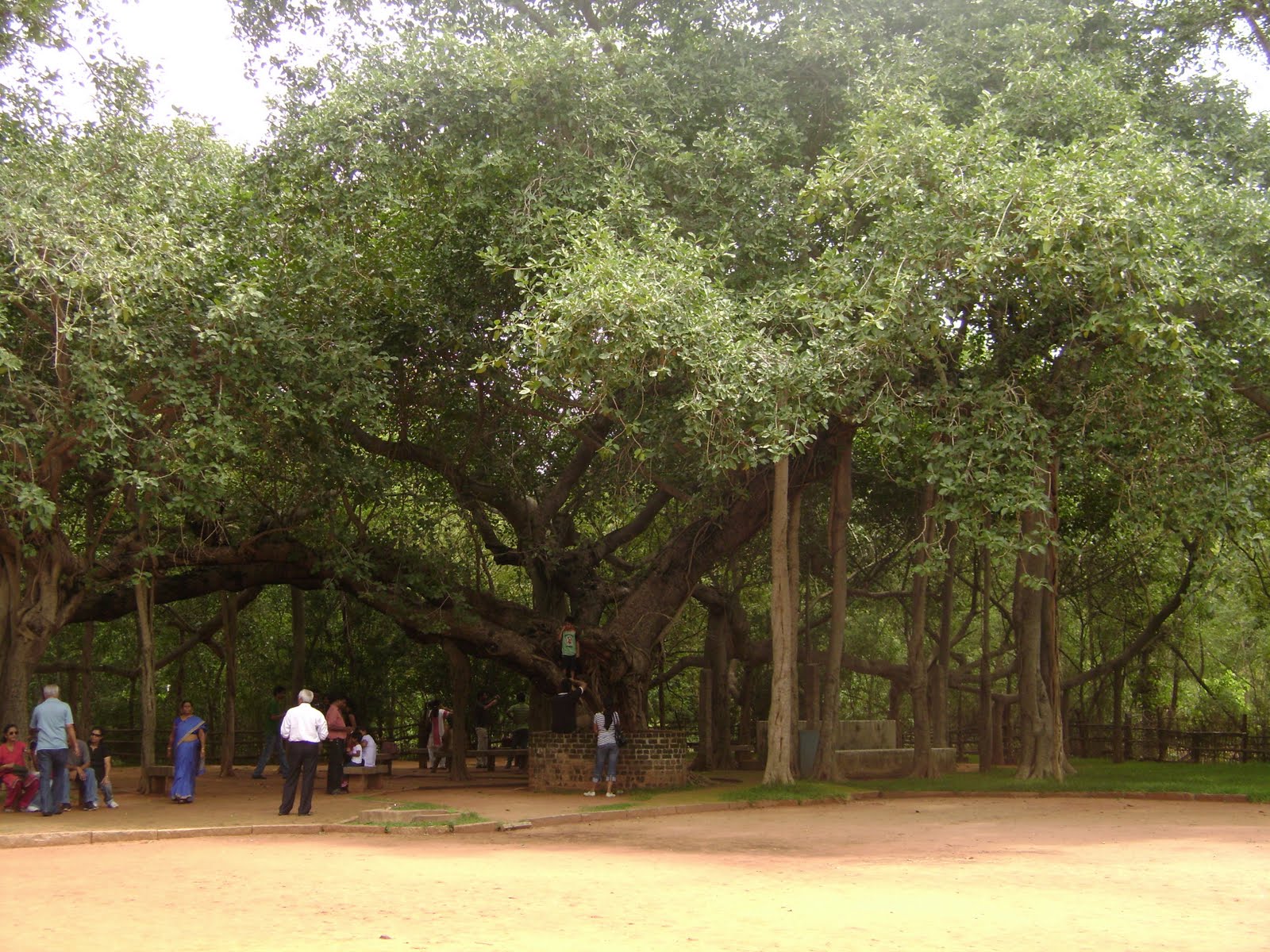
The pride of Auroville is the Matrimandir, a standing about a 100 feet tall, Matrimandir, a Sanskrit word for Temple of the Mother, is a testament to human creativity and imagination. It is surrounded by 12 pedestals, made in such a way that the entire structure is supposed to resemble a lotus. The entire structure is surrounded by greenery and has a huge auditorium on one side. The Aurovilians like to call the Matrimandir as the center of the entire township, though the actual geographical centre is this behemoth and ancient Banyan tree.
The Banyan Tree

The Matrimandir itself is covered by golden disks which reflect the sunlight falling on them thus appearing quite radiant. There are four main pillars supporting the Matrimandir, each facing the four main directions of the compass, each pillar depicting the four aspects of the mother according to Sri Aurobindo Ghosh. The gigantic dome itself contains a meditation room, also known as the Inner Chamber, having 12 sides. This meditation room contains the largest optically perfect crystal globe. The solar rays are reflected by a mirror mechanism placed on the top of the dome onto this globe. With plans going on to build 12 gardens around the dome, separated by artificially constructed water bodies, Matrimandir sure will be a sight to behold once it reaches its final structure. The inner details of the dome are what I heard on a short video that is shown to visitors at the entrance of Auroville. Visitors are barred from entering the Matrimandir. The reason given that it is a place where you attain maximum concentration and that entry to visitors would only serve to disturb the overall atmosphere of the chamber. The rest of Auroville is replete with natural beauty and is a great sanctuary for anyone wishing to get away from 'it' all. As nerdy as it may sound, I must say that a few sections of the road leading to the Matrimandir were largely reminiscent of Lothlorien and Rivendell. Any LOTR fans out there might know of what I am talking about; as for the rest, I am sorry but this is the only context I could find to describe the beauty of the forest surrounding us.

After having taken in the sights of Auroville to our hearts' content, we commenced our homeward journey for we had one more very important, nay, the most important location to visit. John F. Kennedy once said, "We are tied to the ocean. And when we go back to the sea, whether it is to sail or to watch - we are going back from whence we came." I don't know whether we came from the sea or because God said 'Let there be light', but one thing I know for sure is that there are very few sights in the world which parallel the blue ocean stretching out beyond the horizon, swallowing the sun as it begins its downwards journey to signal the end of yet another day in our puny, insignificant lives. The serenity and the beauty that it offers is unparalleled in anywhere. If Auroville offered a great sanctuary from the daily tortures in our lives, a clean, blue-watered beach offers the ultimate retirement home, a place to bury all you troubles beneath the sand and letting them be washed away by the pure blue waters. I must confess that I have no idea about the name of the beach that we visited. Our aim was to visit the Paradise beach, one of the best, and most popular, beaches in Pondicherry. However, our rickshaw driver suggested this beach to us. It's situated near a small town which gives the beach its name (or is it the other way around?). Having parked our rickshaw, we made our way on the banks of a river joining the sea and is used by the local fishermen for fishing. Past some sand dunes lay the ocean (the Bay of Bengal we were told) in its full majestic glory. Now I have been to a lot of beaches in India, but the only place where I have seen clearer water than this beach is the Port Blair. The water actually had a shade of blue; only getting polluted when it reached the shallows and disturbed the sand. It is futile of me trying to describe the scenery in this already long post. A quick dip and a short walk later we were on our way home. The extra time spent at the beach meant that we were not able to make it to the Aurobindo ashram or any other tourist spots in Pondicherry; a fact which seemed to bother me the least after having accomplished what I came to Pondicherry for. Another long walk along the Promenade was followed by dinner and another fantastic evening spent on 'The Roof'.

Day 3 - Farewell to Paradise

And then it was time to go. But not before I had taken another walk on the docks and taken in the early morning sea air sitting on the rock lined on the Promenade. A short bus journey took us to Chennai from where a long bus journey brought us back to Bangalore. An invigorating weekend normally means that you end up going to work with a new zeal and enthusiasm. On the flip side though, if you don't have too much of work, then you actually end up thinking about the weekend and moroseness takes place of cheerfulness.

One last thing before signing off. The weekend we were in Pondicherry marked the beginning of Ganesh Chaturthi. Walking along the Promenade on the last day, I saw a few people immersing the statues of Lord Ganesha into the sea, as is the traditions. Now following traditions is a good thing, but when those traditions don't result into anything good, or rather if they result in some damage only, then its better not to follow them. I don't see the point of immersing the colored idols in the sea. If someone were to try and drown me in water, I would be upset with that person rather than blessing him for doing so. But to each his own, we live in a world where people are ready to slit each other's throats over something as trivial as religion, so I guess our water bodies filling up with idols painted with toxic wastes are the least of our problems.

____________________________________________________________________________________

Click here for the snaps.

Pondicherry - A Slice of Paradise

-----------------------------------------------------------------------------------------------------------------------------------------------------------
this post being a continuation of the account of my trip to Pondicherry


Part 1
-----------------------------------------------------------------------------------------------------------------------------
Day 1 - Exploring the streets

The day began in a rather sleepy manner for us. Having arrived from a tiring overnight bus journey, most of us dropped off for a short nap the moment we got possession of our rooms. A hot shower and a delicious breakfast later we were on our way to explore the city. First stop was the Promenade beach. For those coming from Mumbai, a first glance of this beach might remind them of the Marine Drive. The Promenade beach is named so because of the 1.5 Km long esplanade that hugs the beach. An esplanade, as any dictionary will tell you, is a long, open, level area - mostly besides a water body - constructed for walking; or promenading. The other side of the esplanade joins the road. The refreshing thing about the Promenade is that the opposite side of the road isn't populated with tall commercial hotels and restaurants that seem to pop up at every sea face like weeds in a beautiful garden. There are a couple of guest houses present, but then they don't make a sore sight. Most of the stretch of the road consists of old derelict buildings (which somehow add to the charm of the Promenade rather than making it creepy), some government offices, and a memorial to Dr. Babasaheb Ambedkar (and no, there are no reservations as to who can enter it). The Promenade itself is graced by the statues of Joseph François Dupleix, a Governor General of the French establishment in India, Mahatma Gandhi, and a War memorial. And as I write this log, I realize that it's quite ironic that one of the greatest apostles of peace is surrounded by two memorials depicting the very ideas which he opposed. As you can see in the photo of the esplanade, the esplanade is divided into 2 levels. The one hugging the road is made of concrete and the one hugging the sea and the rocks is made using sand. This walkway continues past the concrete esplanade to a dock and a light house. The dock is not used too frequently except by local fishermen.

Moving away from the Promenade, we walked further into the city. The remarkable thing about the city is that despite being such a popular tourist destination, it has managed to maintain the balance between modernization and old world charm. The outskirts of Pondicherry - the areas nearer to the beaches - still have all the old houses standing up. Like I mentioned before, some of them have even been renovated and converted into guest houses. There are still areas where you will find the cobbled streets surrounded by old Victorian type houses; the likes of which most of us read only in the classic English novels. Despite the strong presence of an era gone by, you can still find a Pizza Hut creeping in here and a CCD there, a lounge appearing almost inconspicuously besides a petrol pump and posh restaurant popping up like a wrinkle on a perfect face. I guess these eye sores are like old age, you just cannot avoid them forever. Again, the traces of the French impact are visible everywhere on the streets. Most streets are named in French, as are a lot of educational and artistic institutions, the Rue's and the Le's visible at almost every corner of the streets. We even managed to mistake a school for a jail. Now I am a terrible guide and have a notorious memory when it comes to remembering roads. But for some reason, I managed to remember almost all the roads and the paths that we traversed. The streets are well connected and easy to remember. Besides, our guest house owner had most graciously provided us with a map of the areas surrounding the guest house. Moving further into the city, we came upon 'The Church of Our Lady of the Immaculate Conception' (called in French as 'The Eglise de Notre Dame de la Conception Immaculee'). Now I have already posted my fascination with churches in one of my earlier posts. This church that we saw was a beautifully built church in a spotless white and golden color. My friend tells me that this is the kind of architecture that is found in very old churches, and he being a better authority than me on churches, I choose to believe him. And, if that is true, then I guess all the churches that we saw in Pondicherry must belong to the old school of church architecture. I won't go into the details of the architecture, but will let the photos speak for themselves. The afternoon heat started getting to us after that, and we turned in for some delicious seafood lunch (in one of the eyesores that I mentioned earlier). Octobers in Pondicherry can be very hot. And the rains start around the same time. The best season to visit Pondicherry is between June to August. Having satiated our taste buds, we ended up going around for some more time. This little trip included a detour to a small but fantastic pastry shop. We left with our stomachs filled to capacity and our pockets considerably lighter.

The day ended with a long walk along the Promenade, some sightseeing along the Promenade, and finally enjoying some nice sea breeze on the rooftop of our guest house. The Roof. That was indeed one of the highlights of the trip. Our French host, in some burst of inspiration, had constructed a roof top kitchen, put some benches and covered the roof with thatched leaves to make it rain proof. What's more, we had a clear view of the Promenade from the roof. Sitting late into the night, listening to the waves crashing on to the rocks and discussing ways to get a permanent job in Pondicherry (from a Government job to the bellboy for our guest house, everything was discussed); for some reason that was one of the biggest highlight of our stay in Pondicherry.


-----------------------------------------------------------------------------------------------------
Further account of this trip continued in the next post.


Click here for snaps.
-----------------------------------------------------------------------------------------------------

Pondicherry - A Slice of Paradise

One year. That's exactly the amount of time that it took me to get my lazy butt outside my house and finally explore the southern parts of India outside Bengaluru. A long weekend beckoned and the prospect of spending another weekend locked in a smelly, dank apartment loomed ominously. That was when a couple of my colleagues suggested a getaway to Pondicherry. I was eager to get out of the city and when you talk about Pondicherry, the first thought on your mind is that magic word: beaches. It took about 1 second for that word to pop into my mind, and one more for me to make up my mind. So Pondicherry it was! By the end of the day, all the preparations were done and all that remained to be done was to wait for the D-day.

Road to Pondicherry

Pondicherry - now known as Puducherry - is one of the seven union territories of India. Situated on the east coast of India, it one of the most scenic places in India with plenty natural as well as man-made marvels to see. Situated at a distance of around 350 Kms from Bengaluru, both these cities are well connected by road. And as any bike enthusiast will tell you, there is no better way to enjoy a scenic ride than on a bike. Feeling the wind brushing your face, the road disappearing underneath the tyres of your ride, and the nature welcoming you with open arms is a feeling that is paralleled by very few experiences in life. Unfortunately, yours truly does not own a bike; hence we had to rely on the humble, yet largely reliable, services of K.S.R.T.C. Now there are two ways to travel by bus to Pondicherry. One is directly between Bangalore to Pondicherry, and the other is by taking a bus to Chennai and then catching the Volvo buses that operate between Chennai and Pondicherry hourly. We took the former option while going to Pondicherry and the latter during the return journey. And as it turned out, it was the right decision to take, as the road between Pondicherry and Chennai is one of the most beautiful ones that I have seen; the only roads that are better being the ones present in Konkan.

Finding a Roof

A roof to hide our heads
As mentioned earlier, we took a direct bus from Bengaluru to Pondicherry. When travelling by bus, a night journey is recommended since travelling by day would mean that most of your day will be wasted (unless you are going for a long vacation). The only disadvantage of a night journey is that, you miss out on the road side exhibition of natural beauty that is on display. But the destination more than makes up for that. And so, having undertaken an overnight journey, we arrived in Pondicherry during the wee hours of the morning. Small, white arched gates welcomed us to the city. Getting down at the local bus stand, we had managed to find our lodgings easily, thanks partly to some over-enthusiastic Rickshawallas (some things never change no matter where you go). There are several options to stay in Pondicherry. The first one is the Auroville Township, situated about 10 Kms north of Pondicherry city. It's a peaceful and serene community founded by Mirra Alfassa. However, more on this subject later. Another option is to stay in regular hotels and resorts scattered over the city; some in the interior parts of the city and some facing the beaches. One more option is to go for the small guest houses run by some of the French settlers here. As you must probably know, Pondicherry was a French colony which was later usurped by the Britishers. As such, you can still find a lot of French and British population living here. Many of these people have converted their old, multi-storied houses into guest houses. Else, they buy old houses from the Indian people living here, renovate them, and then re-open them as guest houses. We went for the last option since the first two options would have burned a big hole in our pockets. Though if you have a fairly big budget, I would definitely recommend the Auroville Township.


-----------------------------------------------------------------------------------------------------
Further account of this trip continued in the next post.


Click here for snaps.
-----------------------------------------------------------------------------------------------------